Wearing a Heart Monitor for 2 Weeks: What to Expect Day by Day

The Short Answer: Wearing a heart monitor for 2 weeks means going about your daily life with a small device on your chest that records your heart's electrical activity around the clock. Most patients keep their normal routine the entire time, log any symptoms they feel, and get test results back from their healthcare provider shortly after the monitoring period ends.
A two-week study is one of the most common lengths a cardiologist will order. It is long enough to catch an irregular heartbeat that a single ECG in the office would miss, and short enough to fit into daily life without much disruption. The questions that come up before day one are usually the practical ones: how the patch feels, what you can and cannot do, and how long results take.
What a Two-Week Heart Monitor Is
A two-week monitor is a portable device that records your heart rhythm continuously while you go about your everyday activities. Most modern versions are a single adhesive patch worn on the chest, about the size of a bandage, with no wires or belt clip.
Your paperwork may use a few different names for these devices:
- Holter monitor: The original ambulatory ECG monitor, traditionally worn for 24 to 48 hours with several leads and a small recorder.
- Cardiac event monitor: A device that records when you press a button or when it detects something on its own.
- Patch monitor: A single-piece wearable device that records without any action from you. Many of these run on mobile cardiac telemetry, and the ZywieNano™ patch falls in this category.
The name matters less than what your care team is looking for. All of these record your heart's activity so a physician can compare what your heart was doing against what you were feeling. If you want a closer look at how two of them differ, see our breakdown of event monitors versus Holter monitors.
Why Two Weeks Instead of Two Days
Holter monitoring for 24 to 48 hours works well when symptoms happen every day. The problem is that most symptoms do not.
Heart palpitations, dizziness, chest pain, and unexplained fainting often show up once a week or once a month. A short holter monitor test can easily miss all of them, and an inconclusive result means starting over.
Longer monitoring periods raise the odds of catching the event that explains your symptoms. In one study of 146 patients who wore both devices at the same time, a 14-day adhesive patch picked up 96 arrhythmia events while a 24-hour Holter monitor picked up 61. That is why extended monitoring has become the standard for suspected atrial fibrillation, ventricular tachycardia, and other abnormal heart rhythms that come and go.
Day by Day: What to Expect
Day 1: Application and Setup
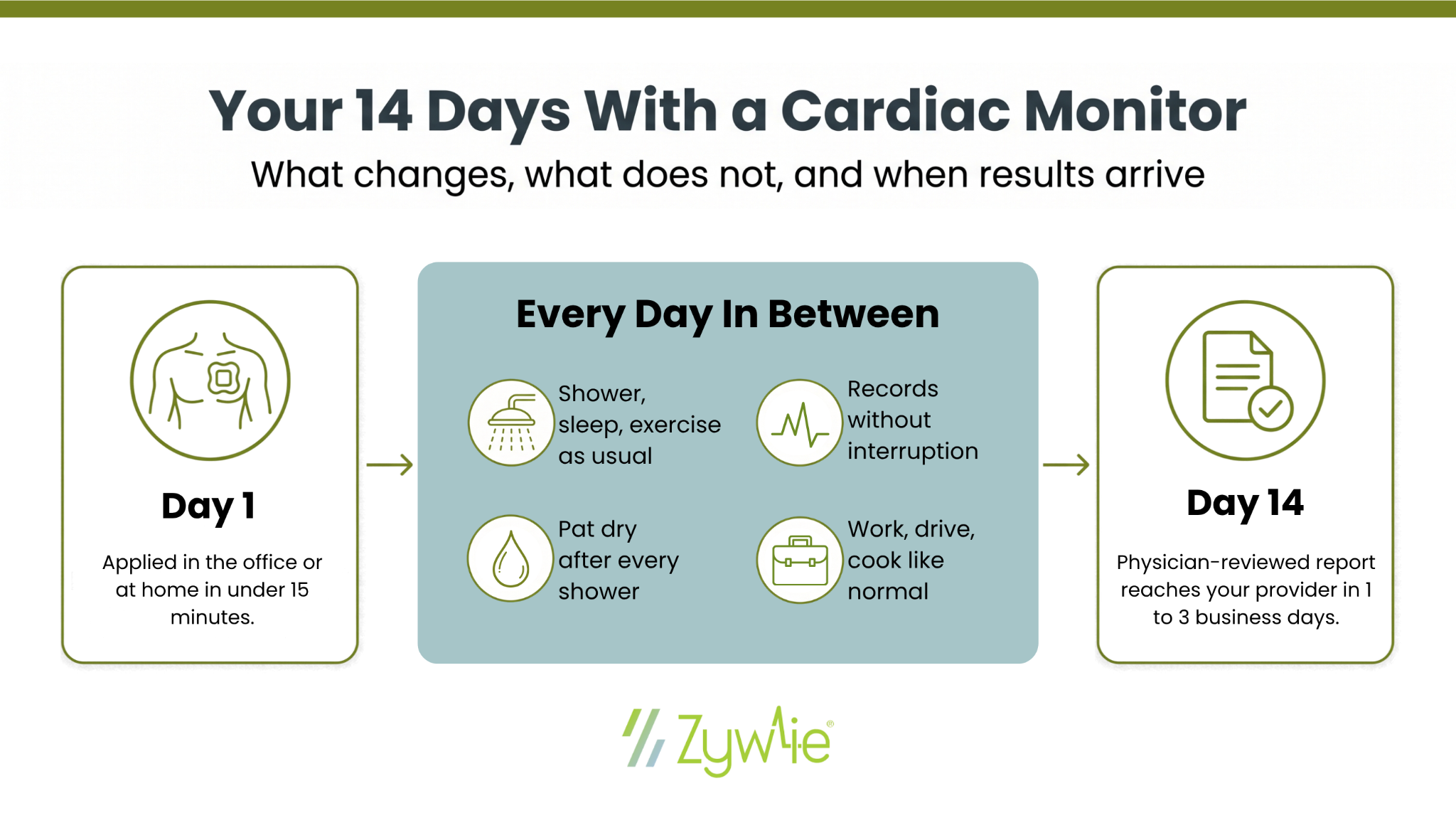
The patch goes on the upper left side of your chest, either in the office or at home if the kit was mailed to you. Setup usually takes less than 15 minutes.
- The skin is cleaned and sometimes shaved so the adhesive patch sticks well.
- Your care team shows you how to log a symptom, either in an app or on paper.
- You will get a phone number to call if the device comes loose or if there is a connectivity issue.
Most people notice the patch for the first few hours and then stop thinking about it.
Days 2 to 3: Settling In
The adhesive feels most noticeable during the first couple of days. Two habits to build early:
- Log every symptom: note the time and what you felt, even if it seems minor.
- Leave the patch alone: picking at the edges shortens how long it stays on.
Days 4 to 7: Back to Your Normal Routine
By the end of the first week, many patients barely notice they’re wearing their monitor. The ZywieNano™ Patch’s small, discreet, bandage-like design allows patients to maintain their normal daily routines with minimal disruption- working, driving, cooking, walking, exercising, and sleeping as usual.
The ZywieNano™ Patch is also waterproof, allowing patients to shower confidently while continuing their monitoring. Restrictions may apply to prolonged or full submersion, such as prolonged swimming, baths, and hot tubs.
Days 8 to 13: Adhesive and Skin Care
During this stage of monitoring, patients may need to replace and reapply the adhesive using the accessories provided in their ZywieNano™ kit. Proper adhesive care helps keep the device secure and comfortable throughout the monitoring period.
- After showering, gently pat the area dry rather than rubbing it.
- Avoid applying lotions, oils, or powders near the device, as these can affect adhesion.
- When the adhesive needs to be changed, follow the provided instructions and use the replacement adhesive and accessories included in your kit.
- Mild redness may occur. If you experience burning, blistering, significant irritation, or a rash that extends beyond the adhesive area, contact your healthcare team.
- If the adhesive begins to loosen or lift, replace it as directed rather than attempting to secure worn adhesive.
Day 14: Removal and Return
At the end of your monitoring period, it’s time to remove and return your device. Gently peel the patch away from your skin, starting at one edge and removing it slowly, similar to a bandage. Warm water can help loosen the adhesive if needed.
Once removed, place the device in the provided return box and prepaid mailer and send it back to Zywie; there’s no need to arrange or pay for return shipping.
Throughout your study, your heart rhythm data is transmitted to Zywie for ongoing monitoring and review. After your study ends, the complete data is analyzed, and your final report is typically delivered to your healthcare provider within an average of 1–3 business days, giving them a comprehensive view of your heart rhythm throughout the monitoring period.
What You Can and Cannot Do
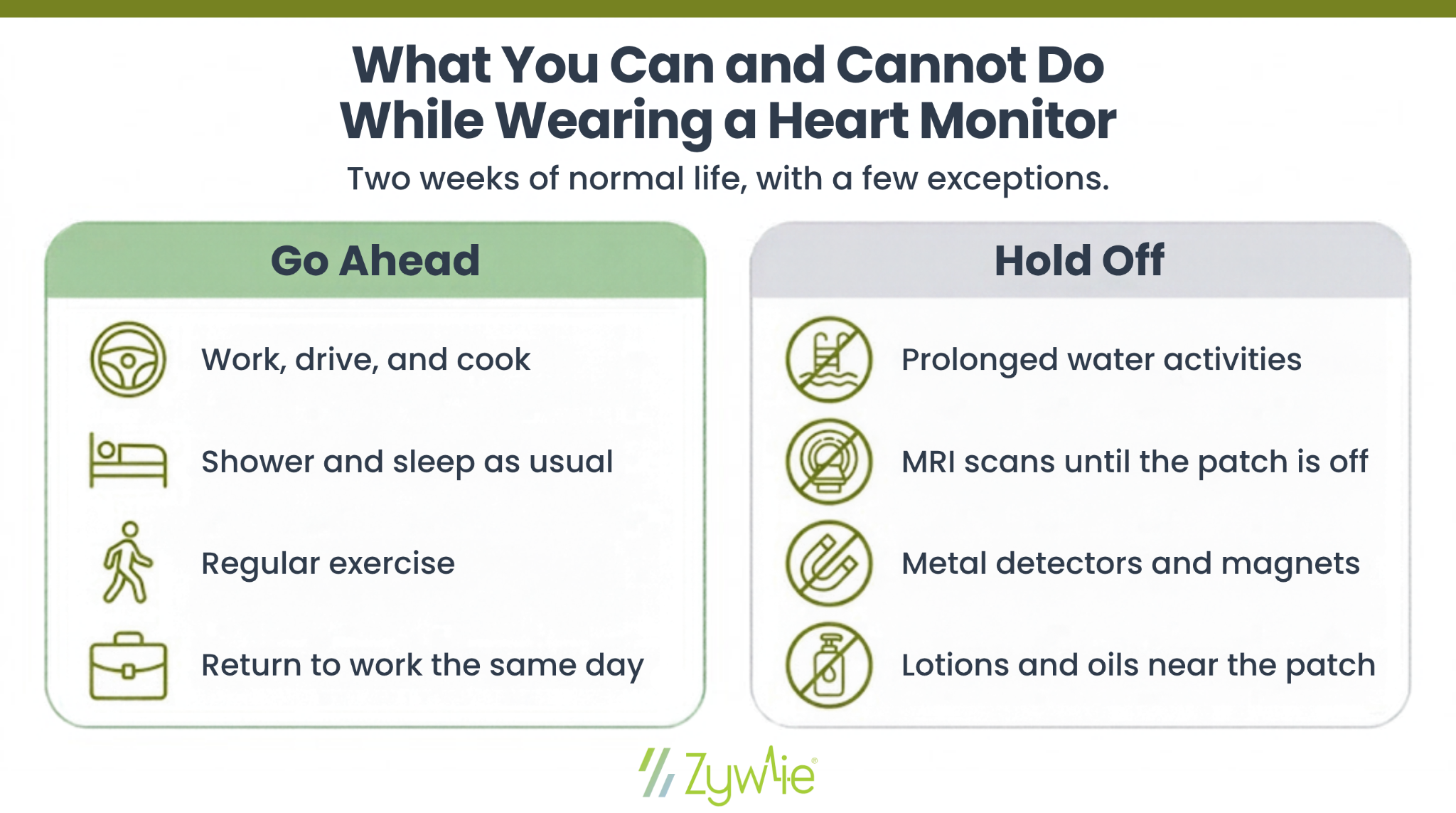
Most of your two weeks looks like a normal week. A few things change:
- Working, driving, cooking, and light exercise: Fine. Keep your usual routine.
- Showering: Fine with most water-resistant devices. Pat dry instead of rubbing.
- Swimming, baths, and hot tubs: Off limits. Full submersion can damage the device and lift the adhesive.
- Metal detectors, magnets, microwaves, and electric blankets: Avoid these, since electrical signals can interfere with how the monitor records. Tell airport security you are wearing a cardiac monitor.
- MRI scans: Not while wearing the device. It has to come off first.
Sweating heavily can loosen the adhesive, so heavy workouts and saunas are worth avoiding until the study ends.
When to Call Your Healthcare Provider
Reach out during the monitoring period if you notice:
- Severe chest pain, fainting, or trouble breathing, which is a reason to seek emergency care
- The patch fully falling off or a connectivity problem
- Skin irritation that gets worse instead of better
- A stretch of hours where you are unsure the monitor was recording
Getting Your Test Results
Once the study ends, the recording is analyzed and reviewed by a physician, then a report goes to the provider who ordered it. Turnaround is typically a few business days, and your provider's office will contact you to go over what the report shows.
Where Two Weeks Fits in Your Diagnosis
Wearing a heart monitor for 2 weeks is straightforward: a small device on your chest, a symptom diary, and your normal daily routine. The recording gives your healthcare provider real data on your heart health instead of a single snapshot taken in an exam room.
For patients with infrequent symptoms, longer is often better. Zywie Healthcare's ZywieNano™ patch records continuously for up to 30 days and transmits data to a physician-reviewed monitoring center in near real-time, so findings reach the care team without waiting for a device to come back. Zywie's own clinical data show 16 to 28% higher detection of first atrial fibrillation, pause, and ventricular tachycardia events between days 15 and 30 compared with a 14-day study.
Explore the ZywieNano™ device suite or contact Zywie Healthcare to learn how extended cardiac monitoring fits your care.
Join Us in Revolutionizing Cardiology – Let's Transform Heart Health Together