FOR PROVIDERS
ZywieNano™ Patch: Heart Monitor for SVT
Episodes that start and stop on their own can be difficult to capture. Continuous cardiac monitoring for up to 30 days provides a more complete picture, capturing the onset, duration, and termination of intermittent arrhythmias to give providers greater insight into what’s happening between visits.


No bigger than a bandaid!
SVT Ends Before Most Patients Reach a Doctor's Office
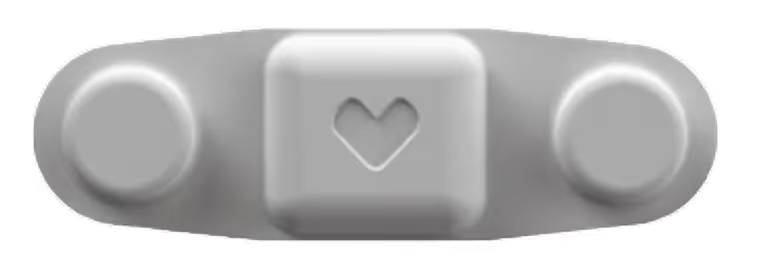
Supraventricular tachycardia arrives without warning, drives the heart rate to 150 beats per minute or higher, and often converts back to a normal rhythm within minutes. By the time the patient reaches a doctor's office, the tracing is unremarkable. The standard workup begins with a physical exam, a 12-lead ECG, and blood tests, then moves to a Holter monitor recording for 24 to 48 hours. Paroxysmal supraventricular tachycardia rarely cooperates with that window, and a clean study does nothing to rule the diagnosis out.Longer ambulatory recording has changed what a workup can document. The ZywieNano™ Patch is a mobile cardiac telemetry (MCT) monitor that captures the heart's electrical signals continuously for up to 30 days and transmits through Zywie's AI-driven platform for near real-time review. When an SVT episode fires, the abrupt onset and the equally abrupt termination are both on the record, which is the detail that separates a reentrant rhythm from a gradual rise in sinus tachycardia.Light and low-profile, the Zywie Nano™ Patch records high-fidelity ECG while your patient goes about ordinary daily activities.
Learn More

90mm


28mm

Getting the Episode on Record
Prescribe and Apply
Place the order through the process you already use. The patch goes on during a visit, or it ships to your patient with a short illustrated card for placement at home, with no electrode set to position.
Continuous Monitoring
Recording runs without interruption for the full study, awake and asleep. Your patient taps to mark the start of each fast heartbeat, wave of chest pain, or lightheaded spell, and the tracing at that second is preserved alongside the note.
Detailed Test Results
Your patient returns the patch by mail once the study ends, and a report reaches your office in 1-3 business days. It lays out every tachycardia run with its rate and duration, the onset and offset pattern, heart rate trends, and each logged symptom lined up with the rhythm.
When to Order Cardiac Monitoring for Suspected SVT

Continuous recording matters most when episodes come and go on their own schedule. Common clinical indications include:
- Abrupt palpitations or a racing fast heartbeat with a clear start and stop, unconfirmed by a resting ECG
- Suspected paroxysmal supraventricular tachycardia after an unremarkable physical examination and blood tests
- Separating SVT from sinus tachycardia, atrial fibrillation, atrial flutter, or ventricular tachycardia
- Episodes that terminate with vagal maneuvers, which points toward AV node involvement
- Chest pain, dyspnea, or presyncope accompanying a rapid abnormal rhythm
- Documentation of episode frequency and duration before an electrophysiology study or catheter ablation
- Rhythm surveillance after ablation, including asymptomatic recurrence
- Rapid rates in patients with structural heart disease or heart failure, where sustained tachycardia carries added risk
An exercise stress test can reproduce exertional episodes, and an implantable loop recorder suits patients whose episodes are months apart. For nearly every other SVT workup, extended MCT recording documents the rhythm without an implant.
.jpg)
What an SVT Tracing Tells You
Confirming a fast heartbeat is the easy part. The value of a full tracing is in what surrounds the run.
Onset and Termination Identify the Mechanism
SVT typically begins and ends in a single beat, while sinus tachycardia accelerates and decelerates gradually. Capturing both ends of an episode, along with the relationship of each P wave to the QRS, points toward atrioventricular nodal reentrant tachycardia, an accessory pathway, or an atrial tachycardia originating in the right atrium, which shapes the conversation about ablation.
Rate, Duration, and Frequency Guide the Plan
A brief run that stops with a Valsalva maneuver reads differently than sustained episodes lasting an hour. Weeks of recording produce a count, a duration range, and the rates involved, which informs whether the answer is reassurance, medication, vagal maneuvers taught at home, or referral for catheter ablation.
A Baseline You Can Measure Against
Post-ablation recurrence is often silent, and a patient who feels better may still be having episodes. Repeat monitoring compares the same measurements before and after treatment, and near real-time transmission surfaces a sustained run during the study rather than after the patch comes back.
Frequently Asked Questions
What does SVT look like on a monitor?

An SVT episode appears as a sudden jump to a narrow-complex rhythm, usually between 150 and 250 beats per minute, with a regular rate that starts and ends abruptly. The tracing on either side of the run is what makes it identifiable, since a single beat separates a normal rhythm from the tachycardia in most cases of AVNRT and accessory pathway reentry.
Why does a 24-hour Holter monitor often miss SVT?
A Holter monitor records the heart's electrical activity for a day or two through several electrodes and lead wires. Paroxysmal SVT can go weeks between episodes, and a short recording frequently ends before the next one arrives, which produces a normal study in a patient who genuinely has the arrhythmia.
How is the Zywie Nano™ Patch different from a standard Holter?
A single adhesive patch on the chest replaces the electrodes, lead wires, and recorder box, and it runs for up to 30 days instead of one or two. Mobile cardiac telemetry transmits automatically for near real-time review, which raises the odds of documenting an episode and shortens the wait for the healthcare provider to see it.
Can monitoring tell SVT apart from sinus tachycardia or AFib?
Yes. Sinus tachycardia builds and settles gradually in response to exertion, fever, or anxiety, while SVT switches on and off. Atrial fibrillation is irregular rather than regular, and atrial flutter carries its own distinctive pattern. Continuous ECG captures enough of each episode to make those distinctions.
How long should a patient wear the monitor for suspected SVT?
Frequent episodes are usually documented within a 7-day study. A 14-day study suits roughly weekly patterns, and a 30-day study is the stronger option when episodes are scattered across a month or when the record needs to confirm that ablation held. Zywie offers all three lengths.
Does a monitor replace an electrophysiology study?
No. An electrophysiology study maps the circuit and is typically paired with ablation in the same session. Ambulatory monitoring comes earlier, documenting that SVT is present and how often it occurs, which is what supports the referral.
Why does it matter if an episode stops with vagal maneuvers?
A Valsalva maneuver or carotid sinus massage stimulates the vagus nerve and slows conduction through the AV node. An episode that terminates in response suggests the AV node is part of the circuit, and a recorded tracing showing that termination is stronger evidence than a patient's recollection of it.
Can patients shower, sleep, and exercise while wearing the monitor?
Yes. The waterproof patch holds through showering, sleeping, and most workouts, which is useful when episodes tend to follow exertion. Patients should avoid submerging the device, which rules out prolonged swimming and hot tubs.
How quickly will I receive the test results?
Reports arrive at your office within an average of 1-3 business days after study completion.
Join Us in Revolutionizing Cardiology – Let's Transform Heart Health Together
Get in Touch