FOR PROVIDERS
Zywie Nano™ Patch: 14-Day Holter Monitor
Two full weeks of continuous ECG data, built to capture the arrhythmia events that a standard 24-hour Holter monitor frequently leaves undiagnosed.


No bigger than a bandaid!
More Diagnostic Power Than a 24-Hour Holter
For patients whose symptoms tend to surface a few times a week, a single day of recording rarely lines up with an episode. The 14-day Holter widens the recording window enough to reliably overlap with these weekly patterns, while staying short enough to suit a wide range of outpatient workups.
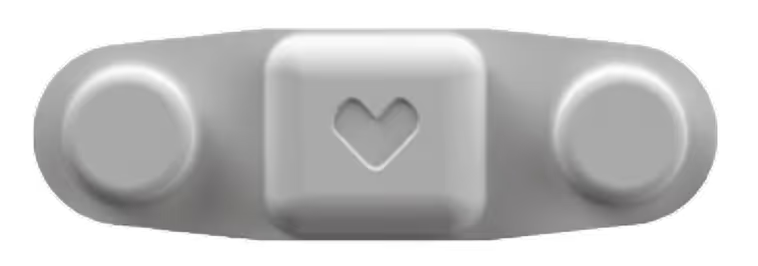
The Zywie Nano™ Patch pairs the diagnostic capability of an ambulatory cardiac monitor with the wearability of a single adhesive patch. Worn directly on the chest, the small device captures the heart's rhythm with beat-to-beat analysis, supporting accurate diagnosis of irregular heart rhythm patterns through AI-driven, near real-time data delivery.
About the size of a Band-Aid, the Zywie Nano™ Patch delivers two full weeks of high-fidelity ECG data without disrupting your patient's daily life.
The Zywie Nano™ Patch pairs the diagnostic capability of an ambulatory cardiac monitor with the wearability of a single adhesive patch. Worn directly on the chest, the small device captures the heart's rhythm with beat-to-beat analysis, supporting accurate diagnosis of irregular heart rhythm patterns through AI-driven, near real-time data delivery.
About the size of a Band-Aid, the Zywie Nano™ Patch delivers two full weeks of high-fidelity ECG data without disrupting your patient's daily life.
Learn More

90mm


28mm

As easy as 1,2,3...
Prescribe and Apply
Order 14-day cardiac monitoring through your standard workflow. The small device is applied in your office or shipped directly to your patient with clear, step-by-step instructions for easy self-application at home.
Continuous Monitoring
The patch monitor tracks the heart's rhythm around the clock for two full weeks, recording every heartbeat while your patient continues daily activities, including sleeping, showering, and exercising without interruption.
Detailed Test Results
Once the monitoring period wraps up, your patient mails the device back. Reports are delivered to your office within 1-3 business days of study completion, including heart rate trends, abnormal heartbeat events, and patient-logged symptoms.
When to Order 14-Day Cardiac Monitoring

A 14-day Holter is among the most prescribed lengths of extended cardiac monitoring, because two weeks of data tends to balance diagnostic yield with patient compliance well. Typical clinical scenarios where a 14-day monitor fits include:
- Suspected atrial fibrillation in patients with symptoms appearing roughly weekly
- Workup of recurring palpitations, dizziness, syncope, or chest pain
- First-line extended monitoring after an inconclusive 24-hour Holter
- Evaluation of recurring symptoms that occur multiple times per week
- Symptom-rhythm correlation in patients whose episodes occur intermittently
- Evaluation for suspected supraventricular tachycardia or ventricular tachycardia
- Rhythm assessment following medication changes for cardiac arrhythmia management
When symptoms appear less than once per month, a 30-day patch monitor or a loop recorder is often the better choice. For most routine arrhythmia evaluations, however, a 14-day monitor delivers strong diagnostic value without asking too much of the patient.
.jpg)
The Right Length for Most Arrhythmia Workups
Diagnostic yield climbs sharply between day one and day fourteen of cardiac monitoring, then begins to flatten. That makes 14 days the most efficient length of monitoring for the majority of arrhythmia evaluations, capturing weekly and biweekly rhythm patterns that a shorter study would miss.
Built for Weekly Symptom Patterns
Most patients referred for cardiac monitoring report symptoms a few times a week. A 24-hour Holter often ends before the next episode, and a 7-day study can come up short for patients on the outer edge of that pattern. Two weeks reliably spans these gaps.
Strong Diagnostic Yield in Two Weeks
A 14-day monitor identifies a significantly larger share of paroxysmal AFib, supraventricular tachycardia, and non-sustained ventricular tachycardia cases than a 24-hour Holter, making it a strong fit for routine outpatient arrhythmia evaluations.
Strong Patient Compliance
Two weeks is long enough to capture meaningful rhythm data and short enough to keep patients engaged through the full monitoring period. Trusted by more than 500,000 patients, the Zywie Nano™ Patch stays on through showers, sleep, and exercise, preserving the integrity of the dataset.
Frequently Asked Questions
How does a 14-day Holter compare to a 7-day monitor?

A 7-day monitor works well when symptoms are happening multiple times per week. A 14-day Holter doubles the recording window, which improves the chance of capturing less frequent episodes and provides a fuller picture of rhythm patterns over time. It is the more common choice when symptom frequency is uncertain or when the referring clinician wants a higher diagnostic yield than a one-week study can offer.
Can patients shower, sleep, and exercise while wearing the monitor?
Yes. The water-resistant adhesive patch stays in place during showering, sleeping, and most forms of exercise. Patients should avoid submerging the device, which means no swimming or hot tubs, but normal daily activities are fully supported throughout the 14 days.
What heart conditions can a 14-day monitor detect?
The device picks up atrial fibrillation, atrial flutter, supraventricular tachycardia, ventricular tachycardia, sinus pauses, AV block, and other forms of irregular heartbeat. Patient-logged symptoms are aligned with the corresponding rhythm events in the final report.
When should I order a 14-day monitor instead of a 30-day monitor?
A 14-day monitor is generally the best fit when patients are experiencing symptoms about once a week or more. A 30-day monitor is more appropriate for patients with rare symptoms, for cryptogenic stroke workup, or when clinicians want to capture the additional 16-28% of arrhythmia events Zywie's clinical data has shown can be detected between days 15 and 30.
How quickly will I receive the test results?
Reports are delivered to your office within 1-3 business days of study completion, including a full rhythm analysis across the 14-day monitoring period, heart rate trends, arrhythmia burden, and any symptom-rhythm correlations.
Is a 14-day Holter more comfortable than a traditional Holter recorder?
By a wide margin. Traditional Holter recorders involve several electrodes, lead wires, and a recording box that patients carry around. The Zywie Nano™ Patch is a single adhesive patch worn directly on the chest, designed for patient comfort throughout the full two-week monitoring period.
Join Us in Revolutionizing Cardiology – Let's Transform Heart Health Together
Get in Touch