FOR PROVIDERS
Zywie Nano™ Patch: Holter Monitor for PVCs
Continuous ECG across up to 30 days, built to quantify PVC burden accurately and reveal the beats that surround it.


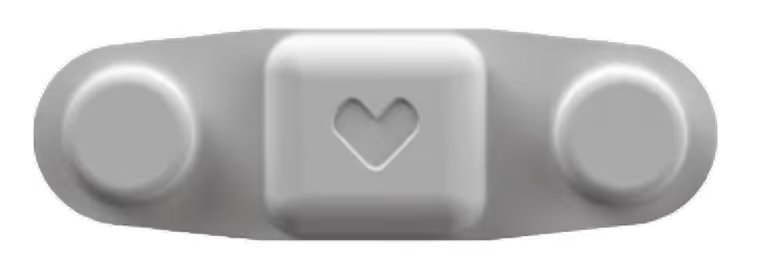
No bigger than a bandaid!
One Day of Data Rarely Reflects True PVC Burden
A premature ventricular contraction begins as an early electrical impulse in the heart's lower chambers rather than the sinus node, producing an extra heartbeat patients feel as a skip or a thud. Quantifying those beats has traditionally meant a Holter monitor recording 24 to 48 hours, but PVC counts swing widely from day to day, and a single-day burden figure can miss the real number by a wide margin. That number carries weight because burden above roughly 10 to 15 percent is where the risk of PVC-induced cardiomyopathy climbs.
Developments in prolonged cardiac monitoring have made a longer window the better pathway for burden quantification. The ZywieNano™ Patch is a mobile cardiac telemetry (MCT) monitor that records the heart's electrical signals continuously for up to 30 days, counting every premature ventricular complex against every normal heartbeat and transmitting through Zywie's AI-driven platform for near real-time review. Small enough to disappear under a shirt, the ZywieNano™ Patch collects high-fidelity ECG while your patient keeps a normal routine.
Developments in prolonged cardiac monitoring have made a longer window the better pathway for burden quantification. The ZywieNano™ Patch is a mobile cardiac telemetry (MCT) monitor that records the heart's electrical signals continuously for up to 30 days, counting every premature ventricular complex against every normal heartbeat and transmitting through Zywie's AI-driven platform for near real-time review. Small enough to disappear under a shirt, the ZywieNano™ Patch collects high-fidelity ECG while your patient keeps a normal routine.
Learn More

90mm


28mm

Order, Wear, Report
Prescribe and Apply
Send the order through your usual referral process. Your patient can have the patch placed in the clinic or receive it by mail with an illustrated card showing where it sits on the chest, with nothing to plug in.
Continuous Monitoring
Every beat is counted for the length of the study, awake and asleep, which builds the burden figure from a full record instead of a sample. Your patient taps to flag each skipped beat, thud, or bout of chest pain as it happens.
Detailed Test Results
Once recording ends, your patient drops the patch in the mail, and your office has a report in on average 1-3 business days after study completion. It gives total PVC count, burden as a percentage of all beats, morphology and pattern detail, heart rate trends, and the patient's symptoms matched to rhythm.
When to Order Cardiac Monitoring for PVCs

A burden figure only carries weight when it reflects more than a single day. Common clinical indications include:
- Frequent PVCs on a 12-lead ECG or physical examination that need accurate burden quantification
- Suspected PVC-induced cardiomyopathy or a declining left ventricular ejection fraction of unclear cause
- Palpitations, chest pain, or shortness of breath that a 24-hour Holter did not explain
- Distinguishing a premature atrial contraction arising in the upper chambers from a ventricular ectopic beat
- Screening for couplets, triplets, or non-sustained ventricular tachycardia among the extra beats
- Baseline burden before catheter ablation and confirmation of PVC reduction afterward
- Response to beta blockers, a calcium channel blocker, corrected electrolyte imbalance, or lifestyle changes
- PVCs in the setting of coronary artery disease, structural heart disease, or heart failure
A monitor works alongside the rest of the workup rather than replacing it. Echocardiography, an exercise stress test, and cardiac magnetic resonance still answer the structural questions, while continuous monitoring answers how many, what kind, and when.
.jpg)
Burden Is Only as Reliable as the Recording Window
Four weeks of counting produces a different number than one day, and the difference often changes what happens next.
Day-to-Day Variability Is the Rule
A patient with 12 percent burden on Monday can record 4 percent on Thursday, and either figure alone could send a treatment plan in the wrong direction. Averaging across weeks smooths that variability and produces a burden number solid enough to act on, including near the thresholds where ablation enters the conversation.
The Beats Around the PVCs Matter
Isolated ectopy reads very differently from couplets, bigeminy, or a run of ventricular tachycardia, and those patterns can appear days apart. Continuous recording also separates a true premature ventricular contraction from a premature atrial contraction and surfaces any coexisting atrial fibrillation, giving a complete account of the irregular heartbeat rather than a count.
A Clear Before and After for Treatment
Once therapy begins, the same measurement answers whether it worked. Repeat monitoring shows how burden responds to beta blockers, a calcium channel blocker, or catheter ablation, and near real-time transmission flags any ventricular arrhythmia that develops during the study rather than weeks later.
Frequently Asked Questions
What is a PVC, and why does burden matter?

A PVC is an extra beat that starts in the ventricles instead of the sinus node, interrupting the normal heartbeat and often felt as a skipped or forceful beat. Burden expresses those beats as a percentage of the total, and a high burden sustained over time can weaken the left ventricle and lead to PVC-induced cardiomyopathy, which makes accurate measurement part of the risk assessment.
How is a Holter monitor used to evaluate PVCs?
A Holter monitor is a portable recorder that captures the heart's electrical activity for 24 to 48 hours through several electrodes and lead wires, typically ordered after a physical exam and a 12-lead ECG. It counts ectopic beats over that window and reports a burden percentage, though a day of data may not represent a patient whose PVC frequency shifts from day to day.
How is the Zywie Nano™ Patch different from a standard Holter?
One adhesive patch on the chest takes the place of the electrode set, lead wires, and recorder box, and it runs for up to 30 days rather than one or two. For PVCs, the difference shows up in the burden figure, which is averaged across weeks of beats rather than a single day, and mobile cardiac telemetry sends the data for near real-time review.
How long should a patient wear the monitor for PVC evaluation?
A 7-day study is often enough when PVCs are frequent and the goal is confirmation. A 14-day or 30-day study is the stronger choice when burden sits near a treatment threshold, when symptoms come and go, or when documenting the result of ablation or a medication change. Zywie offers all three lengths.
Can the monitor tell PVCs apart from PACs?
Yes. A premature atrial contraction originates in the upper chambers and carries a different waveform than a ventricular ectopic beat. Continuous ECG lets the healthcare provider distinguish the two and capture any additional arrhythmia present alongside them.
What causes frequent PVCs?
Common contributors include caffeine, alcohol, nicotine, poor sleep, stress, and electrolyte imbalance; PVCs also appear with coronary artery disease, cardiomyopathy, and other structural heart disease. Many patients with occasional extra beats and a structurally normal heart need reassurance rather than treatment, while frequent PVCs or severe symptoms call for a fuller workup.
Can patients shower, sleep, and exercise while wearing the monitor?
Yes. The waterproof patch stays in place through showering, sleeping, and most workouts, which matters when PVCs increase or suppress with exertion. Patients should avoid submerging the device, which rules out prolonged swimming and hot tubs, and everything else in a normal day is unaffected.
How quickly will I receive the test results?
Reports arrive at your office within an average of 1-3 business days of study completion, covering total PVC count and burden, ectopic patterns, heart rate trends, any additional arrhythmias, and how each logged symptom lines up with the rhythm.
Join Us in Revolutionizing Cardiology – Let's Transform Heart Health Together
Get in Touch