FOR PROVIDERS
Zywie Nano™ Patch: Heart Monitor for PACs
Episodes that start and stop on their own can be difficult to capture. Continuous cardiac monitoring for up to 30 days provides a more complete view of intermittent arrhythmias, capturing when an episode begins, how long it lasts, and when the heart returns to its underlying rhythm.


No bigger than a bandaid!
The Count Matters More Than the Beat
A premature atrial contraction fires early from somewhere in the upper chambers rather than the sinoatrial node, arriving ahead of the next expected beat. Patients often notice it as a brief fluttering sensation, a pause followed by a thump. Occasional PACs turn up in healthy hearts and rarely need treatment. Frequency is the part that changes the conversation, because a high daily count is associated with later atrial fibrillation, and short runs of consecutive atrial ectopy can signal atrial tachycardia or an early episode of AFib. A Holter monitor recording 24 to 48 hours produces a snapshot, and daily counts vary enough that the snapshot may not reflect the pattern.
Prolonged cardiac monitoring answers the frequency question with a fuller record. The Zywie Nano™ Patch is a mobile cardiac telemetry monitor that records the heart's electrical activity continuously for up to 30 days, tallying every premature beat against every beat in normal sinus rhythm and transmitting through Zywie's AI-driven platform for near real-time review. Trusted by more than 500,000 patients who have worn the same patch.
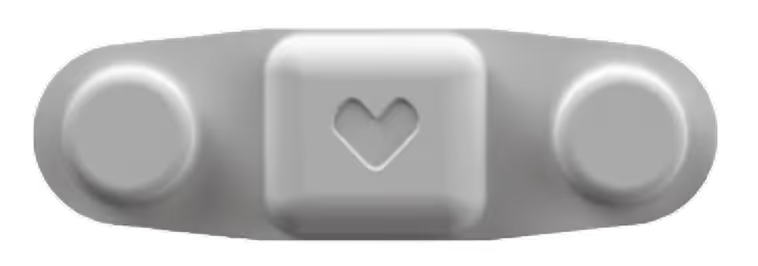
Slim and low-profile, the Zywie Nano™ Patch records high-fidelity ECG while your patient goes about ordinary physical activity.
Prolonged cardiac monitoring answers the frequency question with a fuller record. The Zywie Nano™ Patch is a mobile cardiac telemetry monitor that records the heart's electrical activity continuously for up to 30 days, tallying every premature beat against every beat in normal sinus rhythm and transmitting through Zywie's AI-driven platform for near real-time review. Trusted by more than 500,000 patients who have worn the same patch.
Slim and low-profile, the Zywie Nano™ Patch records high-fidelity ECG while your patient goes about ordinary physical activity.
Learn More

90mm


28mm

Counting Every Beat, Start to Finish
Prescribe and Apply
Send the order through the workflow you already use. The patch is placed during an office visit or shipped to your patient with an illustrated card showing exactly where it goes on the chest, with no electrode set to arrange.
Continuous Monitoring
Recording runs day and night for the length of the study. Your patient taps to flag each fluttering sensation, wave of chest pain, or bout of shortness of breath, which puts the tracing at that second alongside the note.
Detailed Test Results
The patch goes back in the mail once recording ends, and your office has a report within 1-3 business days. It gives total PAC count and daily burden, the longest run of consecutive atrial beats, heart rate trends, any atrial fibrillation or atrial flutter detected, and each logged symptom matched to rhythm.
When to Order Cardiac Monitoring for PACs

Continuous recording earns its place when the question is how often the extra beats occur and what they carry with them. Common clinical indications include:
- Frequent PACs on a resting ECG or physical exam, where the daily count is unknown
- Heart palpitations or a fluttering sensation with no rhythm documented yet
- Screening for atrial fibrillation in patients with a high atrial ectopic burden
- Runs of consecutive atrial beats that may represent atrial tachycardia or supraventricular tachycardia
- Distinguishing a premature atrial contraction from a premature ventricular contraction arising in a lower chamber
- PACs alongside coronary artery disease, congestive heart failure, or a known abnormality of the heart's structure
- Rhythm surveillance after catheter ablation, or after starting beta blockers or calcium channel blockers
An echocardiogram assesses the heart's structure, and blood pressure and thyroid studies belong in the same workup. Extended monitoring answers the rhythm question those tests cannot.
.jpg)
What a Full Count Reveals About Atrial Ectopy
One tracing confirms that premature beats exist. Weeks of recording show what they mean.
Burden Separates Benign From Notable
Ectopic heartbeats scattered across a day are a different finding than thousands, and studies have tied a high daily PAC count to an increased likelihood of developing atrial fibrillation. Averaging the count across weeks produces a number stable enough to guide whether the answer is reassurance and lifestyle changes or closer follow-up.
The Runs Are the Warning Sign
Isolated premature beats matter less than what happens when several fire in sequence. Continuous ECG captures the length of every run, which distinguishes a benign couplet from atrial tachycardia, an episode of atrial flutter, or the first documented AFib in a patient who has never had it recorded.
The Origin Is Visible in the Tracing
An early beat from the upper chambers carries a different P wave and QRS shape than one originating below the atrioventricular node. Recording every beat lets the healthcare provider separate atrial from ventricular ectopy, which points toward entirely different treatment options and follow-up.
Frequently Asked Questions
What do PACs look like on a heart monitor?

A premature atrial contraction appears as a beat arriving earlier than expected, with a P wave shaped differently from the ones the sinus node produces, followed by a narrow QRS and usually an incomplete pause before the rhythm resumes. On a monitor report, they are counted individually and summarized as a daily burden.
Are frequent PACs dangerous?
Occasional PACs are common and generally benign. A consistently high daily count is a different matter, since frequent atrial ectopy is associated with a higher likelihood of developing atrial fibrillation and may reflect an underlying heart problem worth investigating. Knowing the count is what separates the two situations.
How is the Zywie Nano™ Patch different from a standard Holter monitor?
One adhesive patch on the chest replaces the electrodes, lead wires, and recorder box, and it runs for up to 30 days rather than one or two. That matters for PACs because daily counts fluctuate, and near real-time transmission means a run of atrial fibrillation surfaces during the study instead of after the device is returned.
Can monitoring tell PACs apart from PVCs?
Yes. A premature atrial contraction starts above the atrioventricular node and produces a narrow QRS, while a premature ventricular contraction originates in a lower chamber and produces a wide one. Continuous recording captures both and reports them separately.
How long should a patient wear the monitor for PAC evaluation?
A 7-day study usually suffices when the goal is documenting symptoms tied to frequent extra beats. A 14-day or 30-day study is the stronger choice when the burden number will guide follow-up or when the concern is undocumented atrial fibrillation. Zywie offers all three lengths.
What causes premature atrial contractions?
Caffeine, alcohol, nicotine, stress, poor sleep, and dehydration are frequent contributors, and PACs also appear with heart disease, congestive heart failure, thyroid dysfunction, and sleep apnea. Many patients improve with lifestyle changes alone, while a persistently high burden or an accompanying abnormal heart rhythm calls for a fuller evaluation.
Can patients shower, sleep, and exercise while wearing the monitor?
Yes. The water-resistant patch holds through showering, sleeping, and most workouts, which is worth having on record when extra beats increase or subside with physical activity. Patients should avoid submerging the device, which rules out swimming and hot tubs.
How quickly will I receive the test results?
Reports arrive at your office within an average of 1-3 business days of study completion, covering total PAC count and daily burden, the longest atrial run, heart rate trends, any additional arrhythmias, and how each logged symptom lines up with the rhythm.
Join Us in Revolutionizing Cardiology – Let's Transform Heart Health Together
Get in Touch