FOR PROVIDERS
Palpitations Don’t Follow a Schedule: Go Beyond the Holter with ZywieNano™ Patch
Palpitations can be intermittent and unpredictable. ZywieNano™ Patch goes beyond traditional Holter monitoring with up to 30 days of continuous monitoring and near real-time transmission, giving providers a broader window to capture clinically meaningful arrhythmias when they occur.


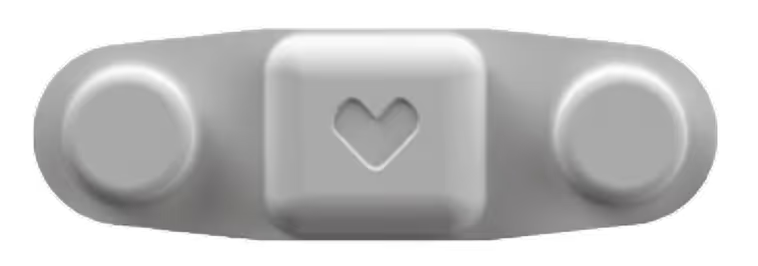
No bigger than a bandaid!
The Problem With Palpitations Is Timing
A patient describes a racing, pounding, or fluttering heartbeat, and the classic next step is a 24-hour Holter monitor recording the heart's electrical activity through electrodes and lead wires. But palpitations come and go. If no episode happens in that day or two, the Holter comes back clean, and the patient leaves without an answer, even when a real arrhythmia is driving the symptom.
Mobile cardiac telemetry changes that workup. The ZywieNano™ Patch continuously monitors the heart’s rhythm for up to 30 days, providing near real-time alerts as the patient wears the device. When palpitations occur, patients have the option to mark their symptoms, helping correlate what they feel with the underlying cardiac rhythm.
Powered by Zywie’s AI-driven platform and reviewed by certified cardiac monitoring technicians, clinically significant events are identified and communicated quickly, giving providers actionable insight when it matters most. Trusted to monitor more than 500,000 patients, Zywie transforms an intermittent symptom into clearer data and a more informed path to diagnosis.
Mobile cardiac telemetry changes that workup. The ZywieNano™ Patch continuously monitors the heart’s rhythm for up to 30 days, providing near real-time alerts as the patient wears the device. When palpitations occur, patients have the option to mark their symptoms, helping correlate what they feel with the underlying cardiac rhythm.
Powered by Zywie’s AI-driven platform and reviewed by certified cardiac monitoring technicians, clinically significant events are identified and communicated quickly, giving providers actionable insight when it matters most. Trusted to monitor more than 500,000 patients, Zywie transforms an intermittent symptom into clearer data and a more informed path to diagnosis.
Learn More

90mm


28mm

As easy as 1,2,3...
Prescribe and Apply
Send the order over however you normally would. The patch is applied in the clinic or mailed to your patient, who places it with a quick walkthrough and no wires to connect.
Continuous Monitoring
The patch records every heartbeat around the clock for the full study, and your patient taps the app to flag each palpitation as it happens, lining the symptom up against the rhythm.
Detailed Test Results
As soon as recording ends, the patch goes back in the mail, and a report lands in your office within 1-3 business days, covering heart rate trends and every logged palpitation matched to its rhythm.
When to Order Cardiac Monitoring for Palpitations

Reach for extended monitoring when palpitations are intermittent, unpredictable, or too infrequent for a single day of recording to catch. Common clinical indications include:
- Heart palpitations accompanied by dizziness, chest pain, or shortness of breath
- Suspected atrial fibrillation, atrial flutter, or supraventricular tachycardia behind the sensation
- Frequent extra beats where symptom-rhythm correlation clarifies the burden
- Palpitations with known heart disease, where ventricular tachycardia must be ruled out
- Rhythm checks after catheter ablation or a new beta blocker
- Palpitations that persist after a normal 24-hour Holter monitor
When episodes are rarer than once a month, an implantable loop recorder may fit better. For most palpitations workups, extended MCT monitoring balances diagnostic yield and patient comfort.
.jpg)
Why the Length of the Study Matters for Palpitations
Holter monitoring gave cardiology its first window into ambulatory ECG, but a symptom that surfaces once a week does not fit inside a 24-hour test. Catching palpitations means recording at the moment one strikes, which favors a longer window with near real-time transmission.
A Day or Two Is Rarely Enough
Palpitations from paroxysmal atrial fibrillation, supraventricular tachycardia, or a run of extra beats can sit quiet for days between episodes. A 24-hour Holter monitor often expires before the next one arrives, so many return normal and prompt a repeat study.
Catch the Rhythm During the Symptom
With palpitations, the question is what the heart is doing the instant the patient feels it. Pairing each logged episode with the underlying heart rhythm separates harmless extra beats from an arrhythmia that needs a treatment plan. A longer window improves the odds of catching that moment: Zywie's own clinical data shows 16-28% higher detection of first AFib, pause, and ventricular tachycardia events between days 15 and 30 versus a 14-day study.
It Catches What the Patient Cannot Feel
Not every dangerous rhythm produces a palpitation, and brief episodes often end before a patient can react. A standard Holter is read only after it comes back, and an event recorder saves only what the patient notices in time. Zywie’s MCT monitor records every beat and transmits automatically, so the rhythm behind a palpitation, and the ones the patient never feels, surfaces during the study, not weeks later.
Frequently Asked Questions
What is a Holter monitor, and how is it used for palpitations?

A Holter monitor is a small, portable recorder that captures the heart's electrical activity for 24 to 48 hours through several electrodes and lead wires. Ordered after a history, physical examination, and 12-lead ECG, it is the traditional way to look for an irregular heartbeat behind palpitations, though episodes outside that short window go undetected.
How is the Zywie Nano™ Patch different from a 24-hour Holter monitor?
It trades the electrodes, lead wires, and belt-worn recorder for one adhesive patch, and records for up to 30 days instead of one.
Are palpitations always caused by a serious heart condition?
No. Many palpitations are benign extra beats that need no treatment, while others point to atrial fibrillation, supraventricular tachycardia, or ventricular tachycardia. Continuous monitoring tells one from the other by matching each symptom to its underlying cause.
How does it compare to an event monitor or implantable loop recorder?
An event recorder saves a strip only when the patient presses a button, so a brief palpitation, or one felt during sleep, can be lost. An implantable loop recorder suits patients who need months or years of surveillance. The Zywie Nano™ Patch fills the middle, recording continuously for up to 30 days with nothing to activate.
Can patients shower, sleep, and exercise while wearing the monitor?
Yes. The water-resistant patch stays in place through showering, sleeping, and most exercise. Patients should avoid submerging the device, but normal daily activities are supported
How quickly will I receive the test results?
Reports reach your office within an average of 1-3 business days after study completion.
Join Us in Revolutionizing Cardiology – Let's Transform Heart Health Together
Get in Touch