FOR PROVIDERS
Zywie Nano™ Patch: Going Beyond Traditional Holter Monitoring for Arrhythmias
A modern take on Holter monitoring for arrhythmias: up to 30 days of continuous, near real-time ECG in a single patch, catching what a 24-hour study misses.


No bigger than a bandaid!
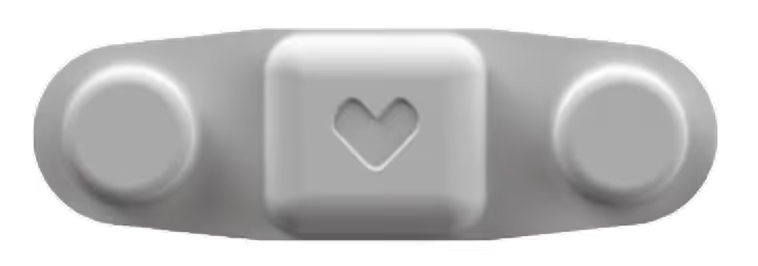
Beyond the 24-Hour Holter Monitor
For decades, the 24-hour Holter monitor was the standard tool for investigating suspected cardiac arrhythmias, recording the heart's electrical activity via several electrodes and lead wires. But many arrhythmias are paroxysmal, coming and going over weeks. When an episode falls outside that short window, 24-hour Holter monitoring often returns a normal result even in patients who clearly have an irregular heartbeat.
The Zywie Nano™ Patch carries the diagnostic strength of a Holter monitor into mobile cardiac telemetry, recording the heart's rhythm continuously for up to 30 days. Worn on the chest, the wearable biosensor captures beat-to-beat data during normal activity, supporting accurate diagnosis of an abnormal heart rhythm. Small and low-profile, the Zywie Nano™ Patch records high-fidelity ECG without changing how your patient goes about the day.
The Zywie Nano™ Patch carries the diagnostic strength of a Holter monitor into mobile cardiac telemetry, recording the heart's rhythm continuously for up to 30 days. Worn on the chest, the wearable biosensor captures beat-to-beat data during normal activity, supporting accurate diagnosis of an abnormal heart rhythm. Small and low-profile, the Zywie Nano™ Patch records high-fidelity ECG without changing how your patient goes about the day.
Learn More

90mm


28mm

As easy as 1,2,3...
Prescribe and Apply
Order the study through your normal process. The patch is applied during a visit or sent to your patient with a short guide for placing it at home, with no wired setup to deal with.
Continuous Monitoring
For the full monitoring period, the patch tracks the heart's rhythm without pause, day and night, while your patient keeps to their usual routine, workouts and sleep included.
Detailed Test Results
At the end of the study, the patch is mailed back, and a report reaches your office in 1-3 business days, detailing heart rate trends, every arrhythmia event, and the symptoms your patient logged.
When to Order Cardiac Monitoring for Arrhythmia

Extended monitoring helps whenever a suspected arrhythmia is intermittent or unlikely to appear in a single day of recording. Common clinical indications include:
- Heart palpitations, dizziness, syncope, or chest pain that points to an arrhythmia
- Suspected atrial fibrillation or atrial flutter not captured on a 24-hour Holter
- Evaluation of supraventricular tachycardia or ventricular tachycardia
- Paroxysmal arrhythmia events that come and go over days or weeks
- Symptom-rhythm correlation when episodes are infrequent
- Rhythm assessment after catheter ablation or a change in antiarrhythmic medication
- Follow-up on atrioventricular block, sinus pauses, or other conduction abnormalities
For symptoms that appear less than once a month, an implantable loop recorder may be the better fit. For most outpatient arrhythmia workups, extended MCT monitoring delivers strong diagnostic yield with high patient compliance.
.jpg)
From 24-Hour Holter to Mobile Cardiac Telemetry
Holter monitoring built the foundation for ambulatory ECG monitoring, but developments in cardiology have shown the value of prolonged cardiac monitoring. For many arrhythmia workups, extending the monitoring window and incorporating near real-time transmission provides greater clinical insight to support faster diagnosis and care decisions.
The Limits of a Short Study
A 24-hour Holter monitor captures only one or two days. Paroxysmal atrial fibrillation, non-sustained ventricular tachycardia, and intermittent pauses can occur days or weeks apart, so a short recording frequently ends before the next event and leaves a real arrhythmia undiagnosed.
Why Prolonged Monitoring Detects More
A longer window overlaps with far more of the heart's activity. Zywie's own clinical data shows 16-28% higher detection of first AFib, pause, and ventricular tachycardia events between days 15 and 30 compared to a 14-day study, catching arrhythmias a shorter study would miss.
Near Real-Time Detection, Not Just Recording
A traditional Holter is a recording device reviewed only after it is returned. Zywie’s device records continuously and transmits automatically, so relevant arrhythmias surface through the platform during the monitoring period rather than weeks later, which matters most for a ventricular arrhythmia that needs a fast response.
Frequently Asked Questions
What is a Holter monitor, and how is it used for arrhythmia?

A Holter monitor is a battery-powered recorder that logs the heart's electrical activity over a day or two using chest electrodes and lead wires. Worn during normal activity, it can flag an irregular heartbeat, but an arrhythmia that occurs less than once a day often slips past its short window.
What does the patch add over a standard 24-hour Holter?
Instead of multiple electrodes, lead wires, and a recording box, it is a single patch on the chest that runs for up to 30 days. Through mobile cardiac telemetry, it transmits for near real-time review, so it catches paroxysmal arrhythmias a one-day study would miss.
What is mobile cardiac telemetry (MCT)?
MCT is a form of ambulatory ECG monitoring that records the heart's rhythm continuously and transmits it for review. Unlike a standard Holter, which is analyzed only after return, MCT flags arrhythmia events as they happen for a faster clinical response.
What arrhythmias can the patch detect?
The device captures atrial fibrillation, atrial flutter, supraventricular tachycardia, ventricular tachycardia, sinus pauses, atrioventricular block, and other forms of irregular heartbeat, pairing each with patient-recorded symptoms in the final report.
How does it compare with an event monitor or loop recorder?
An event recorder only stores a strip when the patient activates it, so asymptomatic runs go unrecorded. A loop recorder is implanted for patients who need months or years of surveillance. The Zywie Nano™ Patch sits in between, capturing every beat for up to 30 days automatically.
Will the patch get in the way of showering, sleeping, or exercise?
No. It is designed to be worn in the shower and overnight, and it handles most workouts. Full submersion is the exception, so patients should skip hot tubs and extreme water sports; otherwise, a normal day is unaffected.
When will results reach my office?
The report is ready on average within 1-3 business days after study completion.
Join Us in Revolutionizing Cardiology – Let's Transform Heart Health Together
Get in Touch